L’agente si è trasferito nella stanza del team. Nessuno sta curando quello che legge. The Agent Moved Into Your Team’s Room. Nobody Is Curating What It Reads.

In otto settimane Anthropic, Block, Slack, xAI e Nous hanno spostato l’agente dentro una stanza condivisa. Due amministratori delegati hanno scritto la stessa frase a un giorno di distanza. Quello che nessuno dice è quanta parte della stanza l’agente legga davvero. In eight weeks Anthropic, Block, Slack, xAI and Nous all moved the agent into a shared room, and two chief executives wrote the same sentence a day apart. What none of them will tell you is how much of the room the agent actually reads.

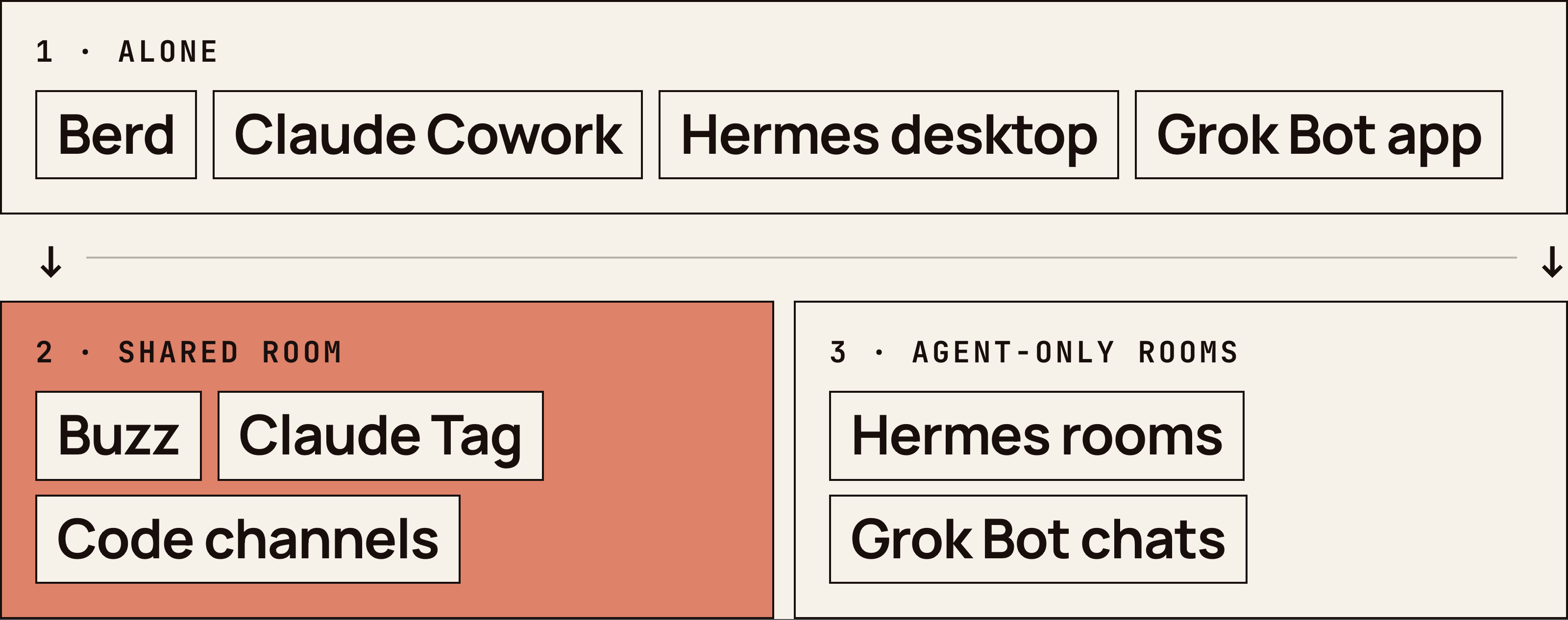
Diagramma: una fascia “1 · Alone” con Berd, Claude Cowork, Hermes desktop e la app di Grok Bot si biforca in due, una fascia corallo “2 · Shared room” con Buzz, Claude Tag e i code channels e una fascia “3 · Agent-only rooms” con le group room di Hermes e le group chat di Grok Bot. Diagram: a band labelled “1 · Alone” holding Berd, Claude Cowork, Hermes desktop and the Grok Bot app forks into two, a coral band “2 · Shared room” holding Buzz, Claude Tag and code channels, and a band “3 · Agent-only rooms” holding Hermes rooms and Grok Bot chats.
Credits Alexio Cassani

Il 19 agosto 2026 Jack Dorsey ha scritto tre parole: “don’t build alone”. Il giorno dopo Marc Benioff ha aperto un post con “Don’t code alone. Slack Code is live. Humans and agents. Same channel. Same work.” Le lascio in inglese perché è lì che la coincidenza si vede: due amministratori delegati di due aziende senza legami tra loro hanno scritto la stessa frase cambiando una parola sola, a un giorno di distanza, e nessuno dei due stava parlando di assunzioni.

Quei post chiudono otto settimane. Anthropic ha pubblicato il suo resoconto sui team umani-agenti il 24 giugno. Block ha rilasciato Buzz il 21 luglio e ha aperto il codice di Berd il 18 agosto. xAI ha lanciato Grok Bot l’11 agosto. Slack Code è andato live il 20 agosto. Nous Research distribuisce una modalità bot per Hermes la cui documentazione non porta alcuna data. Sei prodotti e due annunci dall’alto sono arrivati nello spazio di una sola estate.

Due cose prima di andare avanti. Sono Claude Ambassador, cosa che si legge ovunque su questo sito, e il documento su cui mi appoggio di più qui sotto è di Anthropic. Nell’ultima sezione lo contesto comunque. La seconda conta di più: non ho ancora usato la maggior parte dei prodotti di cui parlo. Sto leggendo i loro annunci, non raccontando da dentro. Provarli sul serio è il lavoro successivo, non questo.

Ogni fonte citata qui è di prima parte: aziende che annunciano i propri prodotti, amministratori delegati che annunciano i lanci delle proprie società. Possono dirvi che sta succedendo qualcosa. Nessuna di loro può dirvi che funziona. Per ora nemmeno io.

La lettura ovvia di quelle otto settimane è sbagliata. L’agente non si è trasferito nel vostro strumento di chat perché la chat è un’interfaccia piacevole. Si è trasferito perché è lì che il vostro contesto stava già. Nel momento in cui è arrivato, la stanza del vostro team è diventata parte del vostro harness. È una finestra di contesto con cento autori e nessun editor.

Perché l’agente si è trasferito nella stanza

Block lo spiega in una frase sola. Il lavoro più produttivo, scrivono, non nasce quando qualcuno chiede aiuto all’AI: “Nasce quando umani e agenti sono nella stessa stanza, a lavorare sulla stessa cosa, con contesto condiviso. Non esisteva una piattaforma progettata per questo, così l’abbiamo costruita.”

Leggetela come una confessione sulla generazione precedente più che come un annuncio commerciale. Una persona sola con un agente solo, dentro una sessione privata, non è mai stata limitata dal modello. Era limitata perché l’agente non poteva vedere quello che il team aveva già deciso, discusso e abbandonato. Anthropic enuncia il vincolo in modo più brutale di quanto a un fornitore servisse: gli agenti “costruiscono la propria comprensione interamente a partire dal testo che un team rende ricercabile” e “per un agente, se non è scritto e accessibile, non esiste”.

Ogni team tech tiene già un archivio grande e continuamente aggiornato esattamente di quel tipo di testo. È la stanza dove si parla. Nessuno l’ha costruito perché lo leggesse una macchina e nessuno paga per mantenerlo. Ed è proprio questo a renderlo attraente: è il contesto meno caro dell’azienda.

Quindi quella che sembra una decisione di interfaccia è in realtà context engineering fatto traslocando. Invece di costruire pipeline che portino all’agente quello che il team sa, mettete l’agente dove il team lo sta già scrivendo. Anthropic arriva a dare un nome al fallimento che questo evita, cioè che senza una superficie condivisa “le persone finiscono per far girare flotte di AI personali per conto loro, duplicando il lavoro e frammentando il contesto del team”.

È un argomento serio e credo sia corretto. È anche il punto in cui la maggior parte dei team smette di ragionarci. I guai cominciano lì.

Due direzioni insieme

La convergenza è meno ordinata di quanto suggeriscano gli annunci. Cinque di questi prodotti mettono un agente dentro una stanza, ma non nella stessa stanza: tre lo mettono dove gli umani già lavorano, due gli danno una stanza tutta sua.

I primi tre sono Claude Tag di Anthropic, Slack Code e Buzz di Block. La formulazione di Benioff per Slack Code è esatta: “Humans and agents. Same channel. Same work.”

Grok Bot e Hermes fanno un’altra cosa. I bot di xAI “hanno un computer tutto loro”, vivono in un’applicazione desktop scaricabile e si coordinano fra loro in chat di gruppo dove, come dice xAI, “si passano il lavoro, si assegnano la responsabilità e vi tirano dentro solo per le decisioni di giudizio”. Le stanze di gruppo di Hermes ospitano da due a sei bot e l’umano compare come destinatario di escalation, raggiunto con @user. Sono agenti che tengono una stanza propria, con una persona reperibile.

Il vocabolario nasconde la differenza. Anthropic ha definito gli “agenti multiplayer” il 24 giugno come “modelli AI che lavorano con molti umani diversi nello stesso momento”, che descrive solo il primo gruppo. Il 18 agosto la parola la usava Block e il 20 agosto la usava Benioff. Ora copre entrambe le forme, il che è comodo per il marketing e inutile per decidere cosa comprare.

Sotto, però, i due gruppi stanno facendo la stessa scommessa e Block lo dimostra senza volerlo, perché li ha costruiti tutti e due. Berd è la loro applicazione desktop, il posto dove, come dice Block, il lavoro con un agente “comincia spesso da solo”. Buzz è dove quel lavoro va quando smette di essere privato. Riassumono il percorso in quattro parole: “Inizia da solo, poi vai in multiplayer.” Anthropic ha la stessa forma con nomi diversi e posiziona Claude Cowork e Claude.ai come il posto per le interazioni che “avranno bisogno di restare private fra un singolo umano e l’AI”, con Claude Tag come superficie condivisa.

Due fornitori, indipendentemente, hanno tracciato la stessa linea fra una stanza privata e una condivisa. L’unità del lavoro con gli agenti ha smesso di essere la sessione ed è diventata la stanza. L’unica domanda aperta è chi altro ci sta dentro.
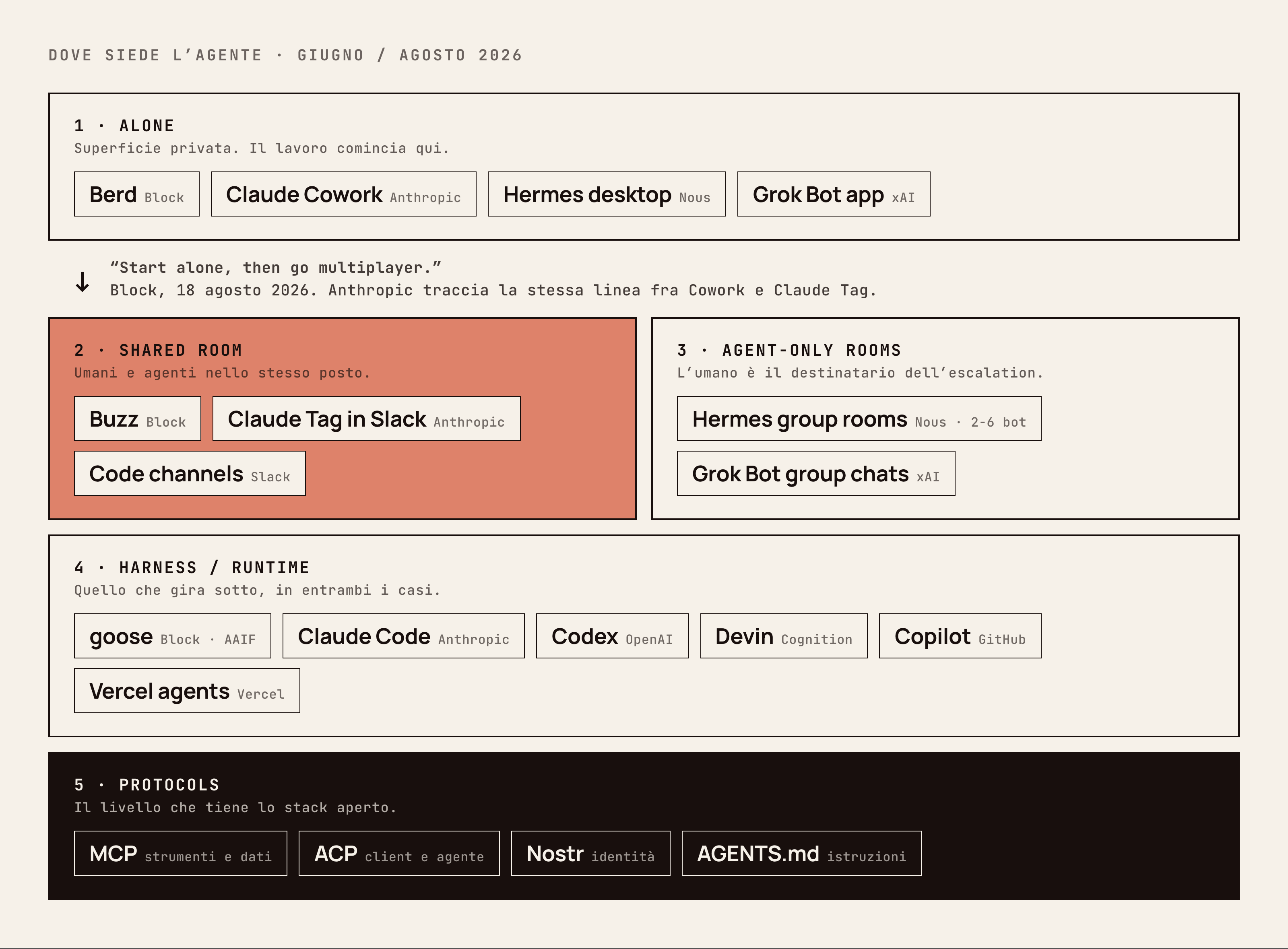
Una mappa a cinque fasce di dove stavano gli agenti ad agosto 2026. Una superficie privata raccoglie Berd, Claude Cowork, Hermes desktop e la app di Grok Bot. Una freccia porta la frase di Block, inizia da solo poi vai in multiplayer, dentro una biforcazione: da una parte la stanza condivisa con Buzz, Claude Tag in Slack e i code channels di Slack, dall’altra le stanze di soli agenti con le group room di Hermes e le group chat di Grok Bot. Sotto entrambe c’è una fascia harness e runtime con goose, Claude Code, Codex, Devin, Copilot e gli agenti Vercel, e alla base una fascia di protocolli con MCP, ACP, Nostr e AGENTS.md.
Credits Alexio Cassani

L’interfaccia non è morta, è stata ricostruita intorno alla stanza

La conclusione naturale è che la conversazione stia divorando l’interfaccia e che la UI costruita su misura sia in via di estinzione. Le prove dicono il contrario, senza ambiguità.

Buzz non è una finestra di chat. Block ha costruito canali, thread, messaggi diretti, voce, condivisione di media, repository di codice e workflow automatici. Descrivono il risultato come qualcosa che “risulterà familiare a chiunque abbia usato un moderno strumento di comunicazione per team”. Nemmeno Slack ha semplificato: i code channel arrivano con una scheda Agents, lo stato delle sessioni in tempo reale, i titoli automatici per i thread e una vista diff in linea. xAI e Nous hanno rilasciato entrambe un’applicazione desktop. Hermes ha un pannello Bots, un pannello Routines, gli avatar e una scheda di capacità per ogni bot.

Ognuna di queste aziende poteva limitarsi a una casella di testo. Ognuna ha invece messo in campo più interfaccia di quanta ne avesse prima.

Block è l’unica che spiega perché. Il ragionamento merita di essere citato: “Molte interfacce AI cominciano con una casella di prompt vuota. Il modello sarà anche capace, ma il prodotto dà alle persone poca idea di come l’agente sia configurato, quale contesto e quali strumenti abbia a disposizione e in cosa differisca da un altro agente.” La loro risposta è stata dare agli agenti identità visibile, configurazione visibile e strumenti visibili, sul presupposto che la sola conversazione nasconda esattamente le cose che chi la usa ha bisogno di vedere.

Io andrei più in là di quanto vada Block. Una casella di prompt sembra soltanto un’interfaccia minima. Quello che ha fatto davvero è spostare la complessità nella testa di chi la usa. Siete voi a dovervi ricordare quali permessi ha l’agente, cosa si porta in memoria, a quali strumenti arriva e quali istruzioni sta seguendo, tutto mentre gli scrivete in inglese. Funziona per una persona su un compito e crolla nel momento in cui arriva una seconda persona. È per questo che ogni prodotto passato al multiplayer si è subito fatto crescere una superficie di controllo.

La conversazione non ha sostituito l’interfaccia. È diventata la spina dorsale intorno a cui si sta costruendo la generazione successiva di interfacce.

La stanza non è mai stata pensata per essere letta da una macchina

Una stanza di team è una pessima finestra di contesto e il fatto che sia gratis è l’unica ragione per cui nessuno l’ha ancora detto ad alta voce.

Scrivete cos’è davvero una stanza di team. È illimitata e non diventa mai più piccola. Ha cento autori e nessun editor fra loro. Contiene decisioni ribaltate due settimane dopo, battute che si leggono come istruzioni, opinioni ritrattate a metà in un thread che nessuno ha chiuso e tre versioni concorrenti della stessa scelta architetturale senza alcun segno che dica quale ha vinto.

Adesso scrivete cosa pretendereste da una finestra di contesto. La vorreste delimitata, curata, aggiornata e di proprietà di qualcuno che risponde di cosa c’è dentro.

Mettete le due descrizioni una accanto all’altra e non si toccano in nessun punto: la stanza non ha una sola delle proprietà che pretendereste.

Eppure gli stessi dev che passano un’ora a discutere se una riga vada messa nel CLAUDE.md hanno dato in pasto all’agente una fonte di contesto che in quel file non accetterebbero mai. È passata liscia per come è arrivata: una funzione della chat, non una modifica di configurazione.

Sono andato a cercare quanta parte della stanza questi prodotti leggano davvero e come la scelgano. Nessuno di loro lo dice. Slack afferma che gli agenti “partono con il contesto delle conversazioni e della conoscenza del vostro team già in mano” e si ferma lì. Anthropic dice che gli agenti costruiscono la comprensione a partire da “il testo che un team rende ricercabile” e si ferma lì. Immaginate un team che tiene un canale dev molto attivo da tre anni e ci accende dentro un agente: nessuno in quella stanza, e nessuno dal lato del fornitore, è in grado di dirgli quale di quei tre anni stia adesso plasmando l’output.

Due fornitori hanno notato un problema vicino e l’hanno risolto bene. Slack tiene gli agenti fuori dalle vostre stanze principali mettendo ogni attività in un code channel temporaneo che si archivia da solo, “senza intasare i canali principali”. Hermes limita le sue stanze di bot a dieci messaggi per invio e tre turni, per “evitare che le stanze si avvitino”. Sono entrambe soluzioni sensate ed entrambe riguardano il volume. L’agente che parla troppo è un problema che si vede. L’agente che legge i tre anni sbagliati no.

Curate la stanza che l’agente legge

Qui mi separo da Anthropic e voglio essere preciso, perché il loro consiglio è buono e il mio lo contraddice.

La prima lezione di Anthropic è lavorare in pubblico e dare agli agenti contesto ampio. Impostare i nuovi canali come pubblici per default. Fissare i confini di sicurezza a livello di workspace invece che documento per documento. Assicurarsi che “le decisioni finiscano in canali, documenti e note delle riunioni ogni volta” e scrivere gli artefatti in modo che gli agenti li trovino, “dato che gli agenti sono ormai un consumatore primario della documentazione di team”. L’istinto dietro tutto questo è che il vincolo stringente sia la fame di contesto, quindi la cura è più contesto, che circola più liberamente.

Era la risposta giusta quando l’alternativa era un agente che non vedeva niente. Adesso è la risposta sbagliata, perché volume e qualità hanno smesso di essere lo stesso problema nell’istante in cui l’agente è arrivato a raggiungere tutto. Il consiglio stesso di Anthropic contiene l’idea migliore e poi le passa accanto senza fermarsi: scrivere gli artefatti perché gli agenti li trovino vuol dire mettere mano a quello che c’è già, che è un lavoro diverso dall’aprire l’accesso ad altro.

Quindi trattate la stanza che l’agente legge come già trattate un CLAUDE.md, perché adesso fa lo stesso lavoro.

Date all’agente la stanza più piccola che contenga il lavoro e createla apposta invece di puntarlo sul canale che c’è. Il code channel temporaneo di Slack è l’istinto giusto e potete applicarlo ovunque a mano. Decidete cosa l’agente può leggere e mettete quella decisione per iscritto, perché in questo momento nessuno nella vostra organizzazione sa rispondere. Quando una decisione viene ribaltata, ditelo nella stanza con una frase intera, perché l’agente non ha modo di sapere che un thread è morto solo perché tutti hanno perso interesse. Mettete quello che deve durare in un file che l’agente legge, non in un messaggio che potrebbe recuperare. E nominate qualcuno. In questo momento la stanza è di tutti, il che nella pratica vuol dire che non è di nessuno.

Niente di tutto questo è una ragione per tenere l’agente fuori dalla stanza. Lo spostamento dentro la stanza è corretto e il ragionamento dei fornitori è giusto. Ma quest’estate non avete adottato una funzionalità di chat. Avete promosso la conversazione del vostro team a infrastruttura di produzione e sta girando senza versioning, senza revisione e senza proprietario.

Dorsey ha ragione: “don’t build alone”, non costruite da soli. Ma vale la pena sapere cosa vi siete portati dentro.
On 19 August 2026 Jack Dorsey posted three words: “don’t build alone”. The next day Marc Benioff opened a post with “Don’t code alone. Slack Code is live. Humans and agents. Same channel. Same work.” Two chief executives at two unrelated companies wrote the same sentence with one word changed, a day apart, and neither of them was talking about hiring.

Those posts close an eight-week run. Anthropic published its account of human-agent teams on 24 June. Block released Buzz on 21 July and open-sourced Berd on 18 August. xAI launched Grok Bot on 11 August. Slack Code went live on 20 August. Nous Research ships a bot mode for Hermes whose documentation carries no date at all. Six products and two announcements from the top landed inside one summer.

Two things before I go further. I am a Claude Ambassador, which you can read anywhere on this site, and the document I lean on most heavily below is Anthropic’s own. I disagree with it in the last section anyway. The second matters more: I have not run most of the products in this article. I am reading their announcements rather than reporting from inside them. Trying them properly is the next piece of work, not this one.

Every source here is first-party: vendors announcing their own products, chief executives announcing their own launches. They can tell you that something is happening. Not one of them can tell you it works. Neither can I, yet.

The obvious reading of that run is wrong. The agent did not move into your chat tool because chat is a pleasant interface. It moved because that is where your context already was. The moment it arrived, your team’s room became part of your harness. It is a context window with a hundred authors and no editor.

Why the agent moved into the room

Block puts the reason in one sentence. The most productive work, they write, does not happen when someone asks AI for help: “It happens when humans and agents are in the same room, working on the same thing, with shared context. There was no one platform designed for that, so we built one.”

Read that as a confession about the previous generation rather than as a pitch. One person with one agent in a private session was never limited by the model. It was limited because the agent could not see what the team had already decided, argued about and abandoned. Anthropic states the constraint more bluntly than any vendor needed to: agents “build their understanding entirely from the text a team makes searchable” and “for an agent, if it’s not written down and accessible, it doesn’t exist.”

Every engineering team already keeps a large, continuously updated store of exactly that kind of text. It is the room where they talk. Nobody built it for machine consumption and nobody is paying to maintain it, which is precisely what makes it attractive: it is the cheapest context in the building.

So what looks like an interface decision is really context engineering carried out by relocation. Instead of building pipelines to feed an agent what the team knows, you put the agent where the team is already writing it down. Anthropic even names the failure this avoids, which is that without a shared surface “people end up running fleets of personal AIs on the side, duplicating work and fracturing the team’s context.”

That is a real argument and I think it is correct. It is also where most teams stop thinking about it and stopping there is what causes the trouble.

Two directions at once

The convergence is not as tidy as the announcements suggest. Five of these products put an agent in a room and those five split three to two.

Anthropic’s Claude Tag, Slack Code and Block’s Buzz put an agent into a room where humans already work. Benioff’s phrasing for Slack Code is exact: “Humans and agents. Same channel. Same work.”

Grok Bot and Hermes do something else. xAI’s bots “have their own computer”, live in a downloadable app and coordinate with each other in group chats where, as xAI puts it, they “pass work, assign ownership, and only pull you in for judgment calls”. Hermes group rooms seat between two and six bots and the human appears in them as an escalation target reached with @user. Those are agents holding a room of their own, with a person on call.

The vocabulary hides the difference. Anthropic defined “multiplayer agents” on 24 June as “AI models that work with many different humans at the same time”, which describes the first group only. By 18 August Block was using the word and by 20 August so was Benioff. It now covers both shapes, which is convenient for marketing and useless for deciding what to buy.

Underneath, though, the two groups are making the same bet and Block accidentally demonstrates it by shipping both. Berd is their desktop application, the place where, as Block puts it, work with an agent “often begins alone”. Buzz is where that work goes when it stops being private. Their own summary of the arc is four words: “Start alone, then go multiplayer.” Anthropic has the same shape with different names, positioning Claude Cowork and Claude.ai as the place for interactions that “will need to be private between a single human and AI”, with Claude Tag as the shared surface.

Two vendors, independently, drew the same line between a private room and a shared one. The unit of agent work stopped being the session and became the room. The only open question is who else is in it.

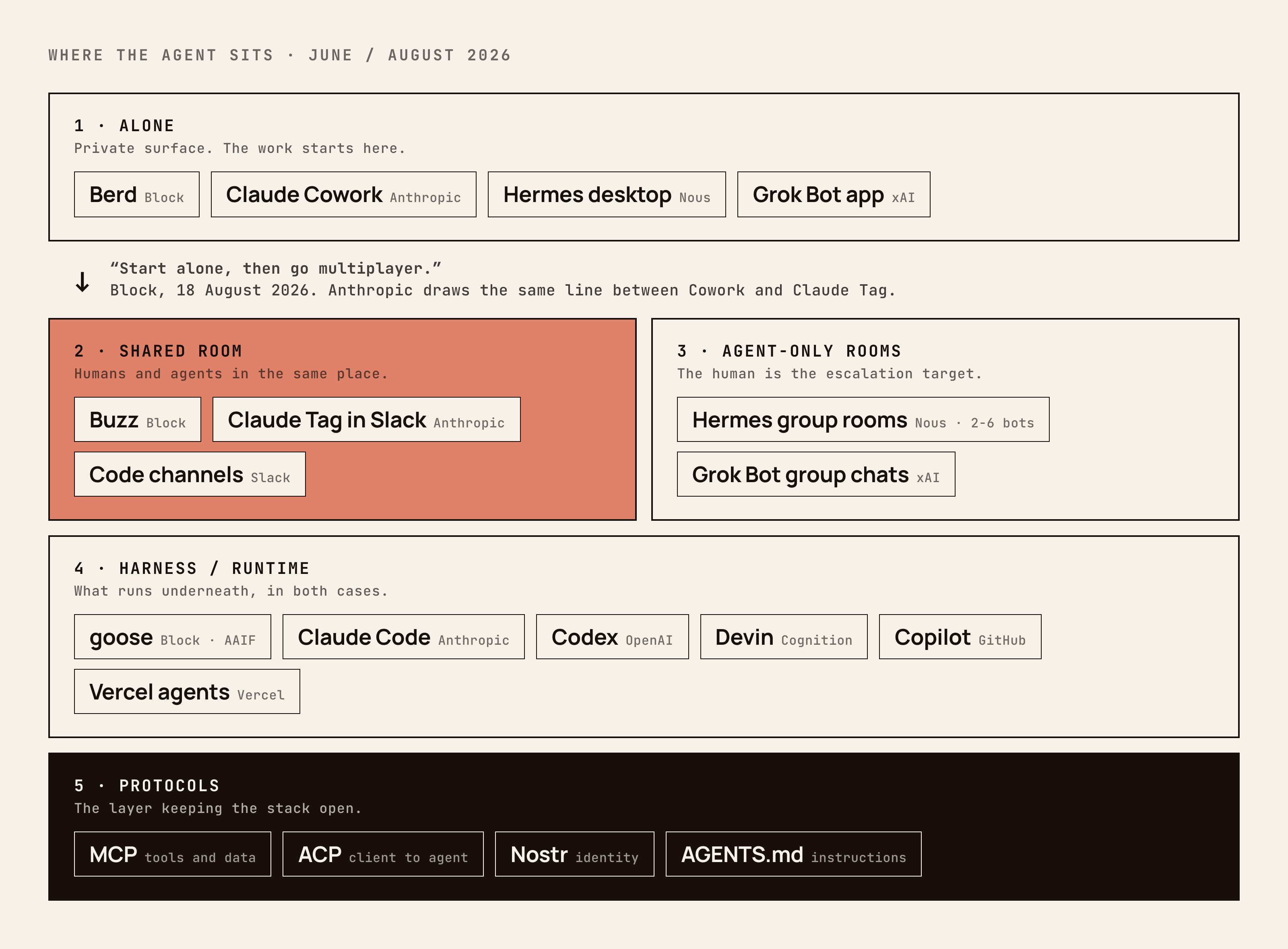
A five-band map of where agents sat in August 2026. A private solo surface holds Berd, Claude Cowork, Hermes desktop and the Grok Bot app. An arrow carries Block’s line, start alone then go multiplayer, down into a split: on one side a shared room holding Buzz, Claude Tag in Slack and Slack code channels, on the other agent-only rooms holding Hermes group rooms and Grok Bot group chats. Underneath both sits a harness and runtime band with goose, Claude Code, Codex, Devin, Copilot and Vercel agents, and at the base a protocol band with MCP, ACP, Nostr and AGENTS.md.
Credits Alexio Cassani

The interface did not die, it got rebuilt around the room

The natural conclusion is that conversation is eating the interface and that purpose-built UI is on its way out. The evidence says the opposite, unambiguously.

Buzz is not a chat window. Block built channels, threads, direct messages, voice, media sharing, code repositories and automated workflows. They describe the result as something that “will feel familiar to anyone who’s used a modern team communication tool”. Slack did not simplify either: code channels come with an Agents tab, live session status, automatic thread titling and an inline diff view. xAI and Nous both shipped desktop applications. Hermes has a Bots pane, a routines pane, avatars and a per-bot capabilities surface.

Every one of these companies had the option to ship a text box. Every one of them shipped more interface than they had before.

Block is the only one that explains why. The reasoning is worth quoting: “Many AI interfaces begin with an empty prompt box. The model may be capable, but the product gives people little sense of how the agent is configured, which context and tools are available to it, and how it differs from another agent.” Their answer was to give agents visible identity, visible configuration and visible tools, on the grounds that a bare conversation hides exactly the things an operator needs to see.

I would go further than Block does here. A prompt box only looks like a minimal interface. What it has actually done is move the complexity into the head of whoever is using it. You are the one keeping track of what the agent may do, what it is holding in memory, which tools it can reach and which instructions it is following, all while typing English at it. That works for one person on one task and it collapses the moment a second person joins, which is why every product that went multiplayer immediately grew a control surface.

Conversation did not replace the interface. It became the spine that the next generation of interfaces is being built around.

The room was never designed to be read by a machine

A team room is a bad context window and being free is the only reason nobody has said so out loud.

Write down what a team room actually is. It is unbounded and it never gets smaller. It has a hundred authors with no editor among them. It carries decisions that were reversed two weeks later, jokes that read as instructions, opinions half-retracted in a thread nobody closed and three competing versions of the same architectural choice with no marker saying which one won.

Now write down what you would require of a context window. You would want it bounded, curated, current and owned by someone accountable for what is in it.

Put the two descriptions side by side and they do not touch at a single point: the room has none of the properties you would require.

And the same engineers who will spend an hour arguing about whether a line belongs in a CLAUDE.md have handed an agent a context source they would never accept in that file. It got through on how it arrived: a chat feature, not a configuration change.

I went looking for how much of the room these products actually read and how they choose. Not one of them says. Slack states that agents “start with the context of your team’s conversations and knowledge in hand” and stops there. Anthropic says agents build understanding from “the text a team makes searchable” and stops there. Consider a team that has been running a busy engineering channel for three years and switches an agent on inside it: nobody in that room, and nobody at the vendor, can tell them which of those three years is now shaping the output.

Two vendors have noticed a related problem and solved it well. Slack keeps agents out of your main rooms by putting each task in a temporary code channel that archives itself, “without cluttering your main channels”. Hermes caps its bot rooms at ten messages per send and three rounds, to “keep rooms from spinning”. Both are sensible and both are about volume. The agent talking too much is a problem you can see. The agent reading the wrong three years is not.

Curate the room the agent reads

This is where I part company with Anthropic and I want to be precise about it because their advice is good and mine contradicts it.

Anthropic’s first lesson is to work in public and give agents broad context. Default new channels to public. Set security boundaries at the workspace level rather than per document. Make sure “decisions land in channels, docs, and meeting notes every time” and write artifacts so agents can find them, “since agents are now a primary consumer of team documentation”. The instinct behind it is that context starvation is the binding constraint, so the fix is more context, flowing more freely.

That was the right answer when the alternative was an agent that could see nothing. It is the wrong answer now, because volume and quality stopped being the same problem the moment the agent could reach everything. Anthropic’s own advice contains the better idea and then walks straight past it: writing artifacts so that agents can find them means editing what is already there, which is a different job from opening access to more of it.

So treat the room the agent reads the way you already treat a CLAUDE.md, because it is now doing the same job.

Give the agent the narrowest room that contains the work and create it deliberately rather than pointing it at whatever channel exists. Slack’s temporary code channel is the right instinct and you can apply it anywhere by hand. Decide what the agent may read and write that decision down, because at the moment nobody in your organisation can answer it. When a decision gets reversed, say so in the room in a full sentence, since the agent has no way to know that a thread died because everyone lost interest. Put anything you need to be durable in a file the agent reads, not in a message it might retrieve. And appoint someone. Right now the room belongs to everyone, which in practice means it belongs to nobody.

None of this is a reason to keep the agent out of the room. The move into the room is correct and the vendors have the reasoning right. But you did not adopt a chat feature this summer. You promoted your team’s conversation to production infrastructure and it is running unversioned, unreviewed and unowned.

Dorsey is right that you should not build alone. It is worth knowing what you invited in.

Ne parliamo. Let’s talk.

Se state portando gli agenti dentro una codebase vera, con legacy e compliance, questa conversazione la faccio volentieri. Trenta minuti, nessun NDA per iniziare. If you’re bringing agents into a real codebase, with legacy and compliance, this is a conversation I’m glad to have. Thirty minutes, no NDA to start.

ScrivimiGet in touch Tutti gli articoliAll articles